
How long will ESG mean different things to different people?

“The balance between the social and environment aspect is very important in Asia as markets are still developing”
CLIFFORD LEE, DBS BANK
KANOL PAL: For us, it is more about sustainability. We look at the whole spectrum of responsible investments, from ESG integration, best in class, sustainability themes (like water or clean energy), to impact investing. ESG is a framework in the investment process analysis comprising the three pillars, in addition to the financial analysis.
Sometimes, people only think about the ‘E’ or the ‘S’ when they hear the word ‘sustainability’, but actually the ‘G’ component is a very important factor to consider in investing.
TOM KEENAN: To us, it is about enhancing returns and making better informed investment decisions. Ultimately, we aim to integrate ESG into our regular investment framework. We also know engagement is really important. Engaging with companies on specific ESG related topics or issues can enable us to unlock value in the companies we are investing in as we make a meaningful ESG impact.
CLIFFORD LEE: We have adopted 6 out of the United Nation’s (UN) 17 sustainable development goals (SDG) to focus on responsible banking, responsible business practices and creating social impact. The balance between the social and environment aspect is very important in Asia as markets are still developing. We’re looking very closely at ESG initiatives that have real-life applications, and make a meaningful impact rather than setting requirements and practices that are not implementable and are merely used to have something on paper.
LESLIE LIM: We think ESG is a good way to capture a lot of real concerns that do not fall into traditional areas. For us, ESG is a no brainer. It’s something everyone should be doing to improve their ability to understand the risks that they’re investing in. As opposed to any particular goal with regards to improving the environment, it is just very basic financial analysis.
MAURICE MEIJERS: We see very little difference between ESG investing and just investing. ESG is becoming critical to any valuation of any company of any stock, of any bond. That is only going to increase, and that wasn’t always the case. Our sustainability unit started in 1995 and it wasn’t until 2009 that the ESG capability got folded into the mainstream business.
JOHAN JOOSTE: There is a growing acceptance in the industry that it’s no longer a niche part of the way you look at stocks or bonds. It is becoming a valuation metric, rather than a product line. Having spent time coping with things like the tequila crisis, the Russian default and then Lehman’s and so forth, you learn that the most important thing about risk management is not quantitative. It’s a simple question – if the worst thing happens today, am I opening my door for business tomorrow? That cuts to the chase in sustainability. That is what ESG is trying to do, because investors have ignored a lot of sustainability issues for a long time.
JOYCE CHEE: Sustainable investing at Credit Suisse is an investment strategy that considers ESG aspects in addition to traditional financial criteria. For single securities, we use a multi-strategy framework that allows our clients to translate their personal values into investment decisions. We believe that enabling and advancing sustainability is a valuable investment for the future. The breadth of our impact work and sustainability efforts is evident throughout the bank worldwide.
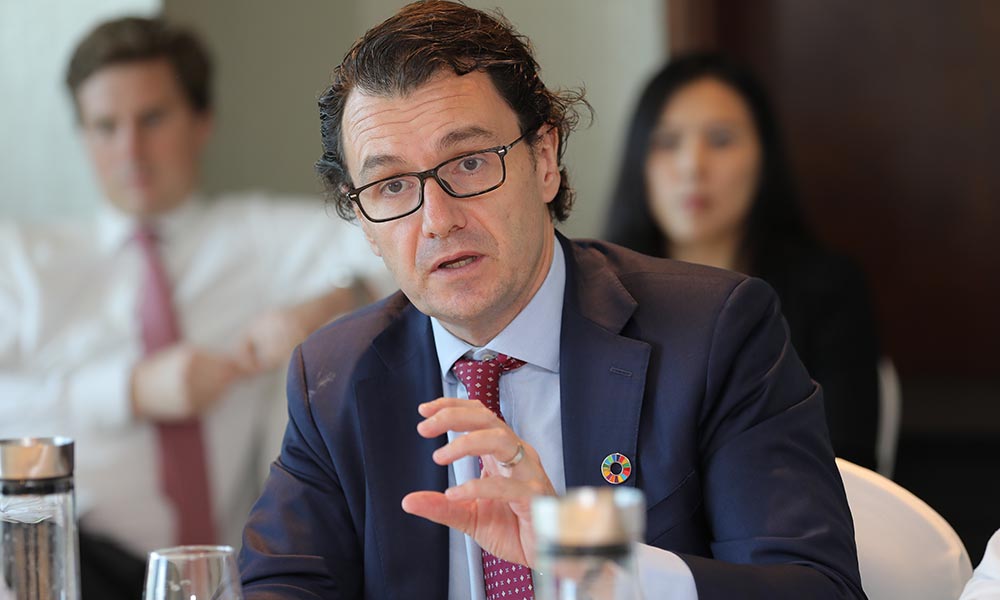
“To get to the mainstream in Asia, we need really strong products, ESG-related products in fixed income.”
TOM KEENAN, ROBECO SINGAPORE
JOYCE CHEE: In Asia, the topic has gained a lot more attention in the last 12 to 18 months. For individual clients, we do see pockets of interest especially when it comes to specific products. This could be thematic, for example a smart mobility product that was launched last year. On the institutional side, when it comes to discretionary mandates, clients are looking at how they can exclude businesses they disagree with. They say: ‘We don’t want to have exposure to gambling and tobacco because it contradicts with our values.’
We observe growing interest from clients who come to us saying, ‘I want a sustainable portfolio. Can you think about it and help me put it together?’ Last year, we supported one of our clients based in Asia who converted an existing fixed income mandate into a sustainable one, and that was about half a billion US Dollars.
AUDREY RAJ: From an institutional client perspective such as private banks, do you feel like there’s still a lack of knowledge and understanding among clients?
CLIFFORD LEE: There’s a lot of awareness, but we’re not there yet. There is a limitation in understanding on the possibilities. We have the private banks who say they want certain sustainability mandates. But in reality, it’s tough to find those products in the market. Private bank fund managers have a big headache if clients say, ‘I have a $500 million portfolio for Asian social bond investments’, for example. They just can’t find those products. The awareness and the interest are growing, but we still need it to mature to a point to be in line with what’s available in the market.
TOM KEENAN: I have seen demand rise in the last two years, but there’s a lot of education required because there’s always this feeling from the end-client that sustainability means some kind of trade off on performance, and that is equities or fixed income. To get to the mainstream in Asia, we need really strong products, ESG-related products in fixed income.
JOYCE CHEE: We have seen a lot of interest especially from Next Generation investors who are keen to align their values with their investments. Many are at the stage where they are actively educating themselves on the topic, and this is a key role advisers can play in connecting and journeying with these Next Generation clients through that process. Slowly but surely as well, investors are starting to shake off the misconception of sacrificing returns, especially when empirical data clearly shows there does not need to be a trade-off.
KANOL PAL: I also work at a private bank and some clients still have the misconception of having to sacrifice returns when we show them a sustainable product. So I agree that we have to demonstrate the opportunities in investing in this new megatrend. In terms of impact investing, it’s not so easy to find products. Sometimes, if you find a good impact investing fund, we find out that the fund’s assets under management are still small, and it’s quite difficult to conduct due diligence for a small fund in big organizations like ourselves. But we continue to educate our clients about the strategic importance of Impact Investing, in line with our vision of providing clients with impact solutions aligned with the UN’s SDGs.
JOHAN JOOSTE: One of the frustrations with ESG is it can be extremely formulaic. You go on to the platform you use, be it Bloomberg or MSCI, and there’s seventy something different formulas, all of which you can screen your stocks. One is a 51 and another one is a 62.5 so, you buy the 62.5 and the 51 is a bit borderline. If they do one or two things wrong, they go below 50 and I have to sell. There you go – you have an ESG portfolio. In time, that might evolve to the point where it’s completely integrated and there is no more such thing as an ESG or a non-ESG portfolio. But in the meantime, you still have this issue of the discount factor.