
Catching the trends

“The private market has a role to play, especially private equity and private debt.”
JOHAN JOOSTE, PURPLE ASSET MANAGEMENT
KANOL PAL: Following the IPO of Beyond Meat, there has been an increasing interest from clients to invest in sustainable food. We always include a smart food fund in our product offer, which did not generate much interest one or two years ago. At that time, clients favoured tech stocks and tech-related funds were doing much better than sustainable food, which is more defensive in general. So the IPO of Beyond Meat and the media coverage on plant-based meats, like Impossible Burger or Beyond Meat have helped people realise that sustainable food is an interesting theme to invest in.
JOHAN JOOSTE: The private market has a role to play, especially private equity and private debt. Not necessarily family offices, but they can take the lead because, often enough, these opportunities are unfashionable. And while they’re unfashionable, they are cheap. If you can get the right capital and the right investors, they are willing to take a long view. That’s probably a better way of getting the job done than waiting for the IPO. If you can get there a step before, the leadership can change. I haven’t seen, to be fair, a large amount of private equity deals in that focus.
AUDREY RAJ: Leslie, from a family office perspective, what are the main trends you see in terms of interest?
LESLIE LIM: I can only speak for the family I represent and I think in some ways we’re at the forefront with regards to how we think about the space. The family is very focused on socially responsible investing and as a starting place, ESG is the minimum. But they do recognise that the market might not be completely there at the moment. So they’re going to give us some time to make the transition from a regular portfolio to a fully ESG compliant one as there are some elements of having the market catch up. The fixed income space is still catching up though. Beyond ESG compliance, we also have aspirations towards impact investing and philanthropy. There is a goal that for some of the organisations we fund on the charitable side, to maybe nudge them towards becoming self-sustaining businesses over time. We’re seeing more opportunities on the equity side and in thematic plays, we have water, sustainability type funds and those are pretty easy. The fixed income side is rather sparse at the moment. I have come across one impact fixed income fund focused on only investing in places that are making an impact, rather than ticking a box. Where it makes sense and see people have good ideas, we are willing to seed funds to the extent that they check the boxes and they advance the progress of their business.
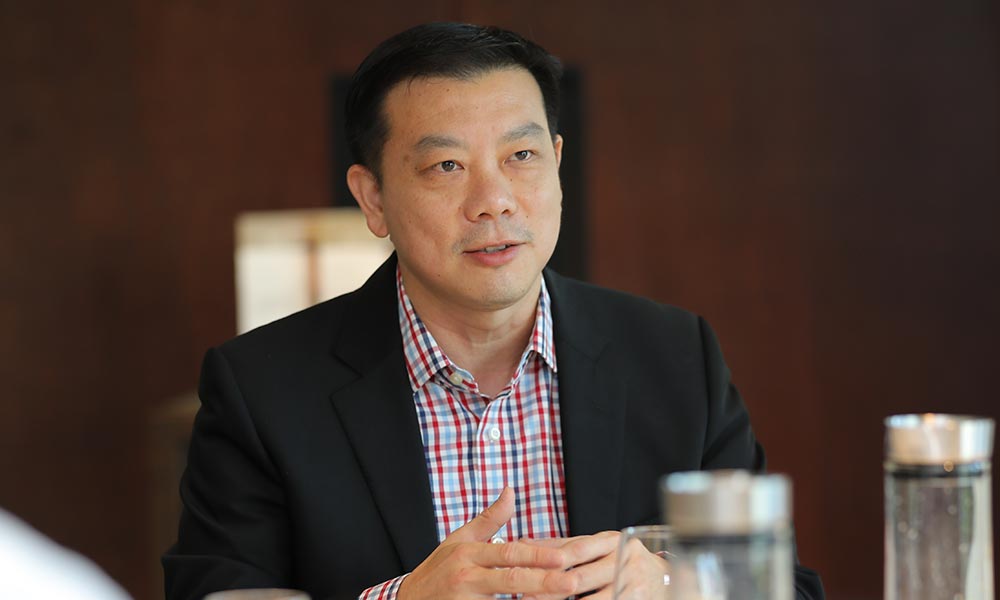
“The family is very focused on socially responsible investing and as a starting place, ESG is the minimum.”
LESLIE LIM, TSAO FAMILY OFFICE
AUDREY RAJ: Joyce, you mentioned that, in Asia especially, investors are keen of economic opportunity. Can you expand on that?
JOYCE CHEE: A few fund managers have said to us that simply deciding on the name of the product, for example whether to, or how to include the word “sustainable” in it requires quite a fair bit of time. For many investors, financial returns are still the primary priority and rightfully so. Our conversations with clients often revolve around, ‘if this sustainable product gives me similar market rate returns’, or ‘this captures a very interesting economic opportunity’, then why not? Positioning of the products to clients from a marketing perspective, require a good balance between the economic opportunity and the expected impact.
TOM KEENAN: On the mutual fund side, whether it be investing in electric vehicles generating alpha, or fixed income and generating yield, if there is any kind of trade off, it doesn’t work. It is up to the fund managers to deliver those dual benefits. Someone outside the industry told me he often gets asked, ‘does sustainability generate better performance?’ But when does the investment industry ever have certainty on an investment? For the sustainability theme or the case for sustainability, we need proof. There is a higher burden here, to demonstrate it is going to work. The reality is, some sustainable investments will not work. Some of them will be very poor investments. Some of them will do really, really well, but that’s the case with every investment we make. We’re taking a risk.
KANOL PAL: When I get that question asked, I never say it always outperforms. It’s hard to do that because you can prove performance in some market cycles and one or two funds might outperform. but I’m telling them, at the end of the day, it’s the skill of the fund manager. Investing is just a framework, but after that you have to pick and choose your stock carefully and I can tell you examples of so many well-known stocks that are going down because of bad business strategies. We do see that. •