
Creating awareness in ESG for fixed income

“[ESG] is a tool and it’s something that analysts have to understand as an additional piece of information that goes into the decision to build a portfolio”
JOHAN JOOSTE, PURPLE ASSET MANAGEMENT
MAURICE MEIJERS: It’s a filter on risk and it’s to complement the overall picture that we have on a company and we’ve been integrating ESG information since about the early 2000s. Most people, when they make an assessment about credit quality, they will look at governance of a company. That makes perfect sense, but to us, it’s about reaching out further for new sources of information. To outperform as active managers, we need to have access to original information not everyone else is using. These days you can download loads of data, but you need to look at things that are relevant for that industry, for that credit and at the same time, and check that it’s impactful for the financials of the company.
JOHAN JOOSTE: The question that comes up if you’re running fixed income or stocks is how much is qualitative and how much is quantitative. What percentage of your return is fintech driven? ESG is the same. It’s a tool and it’s something that analysts have to understand as an additional piece of information that goes into the decision to build a portfolio. The same with all the other data pieces you can get these days. It just gets integrated in the same way we do for any company. When dotcom was going gangbusters in 1999, 2000, someone made the comment, I think it was Warren Buffett, ‘Quite soon everybody’s going to be an Internet company in the same way that everybody is a telephone company.’
CLIFFORD LEE: With regards to fixed income and why we’re facing this continued dearth of supply, is first and foremost the current standards required to issue an ESG-linked fixed income instrument, qualifying it purely from a use-ofproceeds standpoint, and not factoring in other ESG practices of the issuer. What defines a green fixed income instrument might have to be thought of more broadly to grow the breadth and depth of the market. The ultimate intention is to enhance awareness and improve ESG practices. There shouldn’t be any differentiation between the shades of green. It’s just responsible investment, like how an investor can restrict investments into, for example, tobacco, arms distribution, money laundering or illegal gambling. Broadening the definition of what is green or sustainable in a fixed income instrument would really move the needle. If not, we’re just really trying to force a big elephant through a small door. The size of the door being the current restrictive product definition.
TOM KEENAN: Maybe this is where the SDG framework comes into it because it enables us to create a framework that broadens this whole conversation. It creates a framework where you score and measure a company’s contribution to these goals. It’s about scoring these companies contribution and then putting that score into your valuation, which broadens the whole conversation and makes it mainstream.
JOHAN JOOSTE: At some point, you’re going to have to get the rating agencies involved in the debate. What us fixed-income nerds love seeing over the long term is what sort of default rates are you picking up and if there is any difference between companies that trade well in ESG and those that don’t. So, if you say, ‘we introduce this framework. Does it make a difference?’ the only people that can answer that question are the rating agencies. My best guess is, given that you’re taking some risk off the table, I’d quite happily make the case to a private client that in all probability, your default experience is going to be better if your ESG score is better. That’s a fair assessment to make, but I wouldn’t make it until I have the numbers.
LESLIE LIM: Barclays has actually done a study looking back in history and comparing how well companies score in different ESG buckets. I think ‘G’ scores pretty well, ‘S’ was okay and ‘E’ was probably on the weak side. A lot of people are coming up with solutions to tackle the ESG problem, and we recognise that it’s imperfect and it’s a work in progress. There are many creative solutions, but some meet operational challenges like getting information, robust information, and how do you convey that to an investor? When you put it all together, you lose sight of what is the bigger picture. It is useful to advance the industry as a whole by making changes and maybe, over time, a standard will develop. But for now, there are many different approaches.
TOM KEENAN: At Robeco, we’ve done a lot of work across our product range to sort our funds into three broad categories. This is to recognise that different clients are going to require different things when it comes to sustainability. We have funds categorised as ‘sustainability inside’ where the ESG criteria is implemented into its investment process. Then we have ‘sustainability focus’, which takes all of that, plus the fund needs to have a specific target for sustainability. Then we have ‘impact investing’, which is more about specific, tangible, impact-related metrics. We do that to recognise that different clients will have different investment needs or sustainability goals. What that means is nearly everything you buy from Robeco has some form of ESG expertise, and the client can self-select.
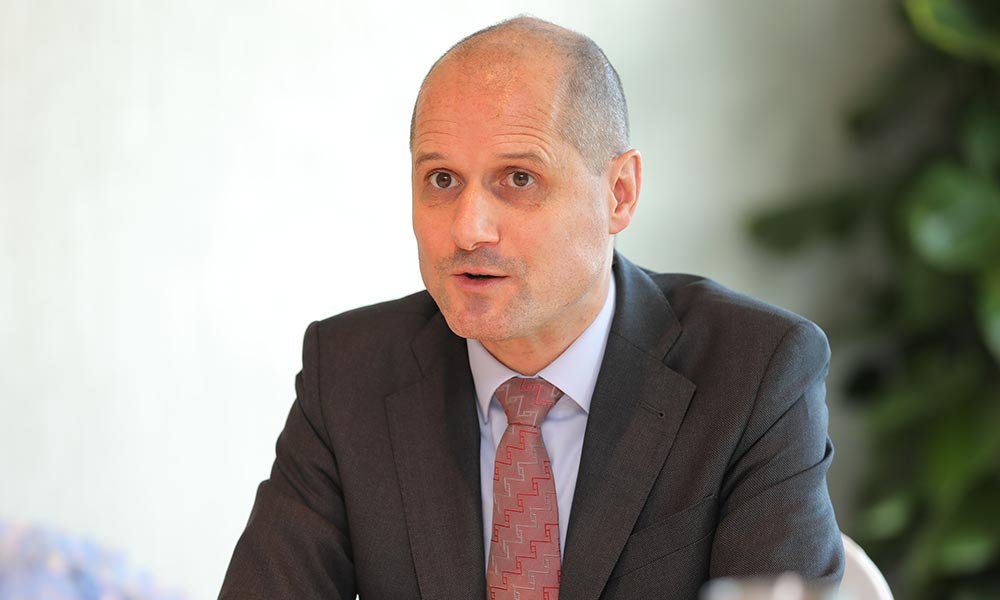
“Most clients will not realise we’ve been integrating ESG to the highest standards since 2008.”
MAURICE MEIJERS, ROBECO FIXED INCOME INVESTMENTS
MAURICE MEIJERS: Our most successful strategy is the high-yield strategy. Most clients will not realise we’ve been integrating ESG to the highest standards since 2008. Most clients buy this on performance. That’s exactly what we want to achieve. Then, there was a competing private bank that was looking for a sustainable option and it didn’t filter this strategy because there was nothing referenced as sustainable or ESG. We had to clarify and say, ‘this strategy has been ESG integrated’.
JOHAN JOOSTE: In fixed income, if you do it right in that way, it’s possible that an additional level of ESG integration for your process can be of demonstrably superior value compared to equities, because you are now explicitly taking away without sacrificing return. You’re taking away some sources of potential default. You’re taking that out of the equation. You might get the same income stream out of the portfolio, but your risk adjusted is going to go up.
MAURICE MEIJERS: That’s where quantitative analysis shows where equities do outperform. So, it’s the opposite of what we’re looking for on the fixed income side. You see that it does really reduce risks.
TOM KEENAN: It’s much easier to demonstrate the risk-management benefits of ESG integration on the fixed income side, than it is for the alphaproducing benefits on the equity side.
MAURICE MEIJERS: The number one question that we receive from clients over and over again is how to show the contribution from the ESG integration. That’s always proven difficult. We’ve got data and the history. I know the Barclays story very well, and they probably have the most extensive dataset available, but to us when we say ESG is integrated, it is truly integrated. So, we can’t really split it for the financial analysis or sector models because that proved difficult, by definition. Now with the SDG framework, what we’ve chosen to do is to compare risk-returns of companies that contribute positively to the SDGs. You do clearly see that particularly the risk reduction is compelling. Even though we do see somewhat higher returns, we could probably take that with a grain of salt. As we all agree, on the fixed-income side, it is all about the risk reduction and reducing the downside risk.